Why my students can no longer read: what 10 years of private tutoring taught me
- education
- reading comprehension
- mental health
What is happening with students?
I have given private lessons of all kinds for more than 10 years to students of various ages, ranging from the beginning of primary education through the end of secondary school or bachillerato, and even adults. Just from my personal experience, I can affirm that the issues seen today are not the same ones seen 15 years ago. Increasingly frequent and serious difficulties with things like sustaining attention or focusing it on something specific, understanding mathematical concepts or finding meaning in their rules, problems expressing themselves, children with anxiety from a very early age… But what I’ve been seeing the most lately, and one of the things that worries me most, is how underdeveloped the skill of reading comprehension has become among young people. How can we help them study if they reach adolescence without knowing how to read?
Reading, a right we cannot take for granted
The United Nations Educational, Scientific and Cultural Organization (UNESCO, 2026) recognizes literacy as a fundamental human right. It is the foundation for acquiring the knowledge, skills, values, attitudes, and behaviors that foster peace. It is also a way of combating poverty and inequality.
Technology in childhood: ban it or allow it?
The advance of technology and the boom of social media has brought about changes in every aspect of human life. This is not about demonizing this progress, but about honestly looking at both its benefits and its adverse effects on society, and taking the necessary precautions before exposing children whose brains are still developing.
The contribution of ICT to collaborative learning
It can be said that, on one hand, ICT (Information and Communication Technologies) enhance collaborative learning, since they facilitate interaction and the exchange of ideas among students. In turn, this cooperative dynamic strengthens reading comprehension by favoring the joint construction of meaning. Furthermore, fundamental digital competencies for today’s context are developed. According to Alarcón and García (2022, as cited in Borbor Tomalá, 2024), the ability to use ICT effectively, search for and evaluate information online, use digital tools, and communicate appropriately in virtual environments is becoming increasingly indispensable, both academically and professionally. In this sense, integrating ICT into the development of reading comprehension also contributes to strengthening these digital competencies (Borbor Tomalá, 2024).
When the screen works against you
However, having technology at hand does not, by itself, guarantee any progress in reading comprehension: it all depends on how these tools are used. Becoming too immersed in a digital environment can end up hindering the acquisition of reading skills that are developed through traditional means (Ruiz, 2026). According to Arab and Díaz (2015, as cited in Ruiz, 2026), overusing social media platforms like TikTok or WhatsApp without adult supervision brings proven negative consequences in various areas: memory, concentration ability, cognitive performance, and reaction times.
What the 2022 PISA report shows
PISA (Programme for International Student Assessment) is an international comparative assessment, promoted by the OECD (Organisation for Economic Co-operation and Development) together with the participating countries. According to the results of the 2022 edition, which assessed 690,000 students from 80 countries, the average performance of the most developed countries dropped 15 points in Mathematics (equivalent to three-quarters of a school year) and 10 points in Reading (half a school year). The OECD itself notes that the average had never varied by more than four points in Mathematics or more than five in Reading between successive assessments, even though four years had passed since the previous measurement in this cycle (RTVE.es, 2023).
Figure 1
Trends in estimated average reading performance between 2012 and 2022 for Spain, the OECD average, and the EU total
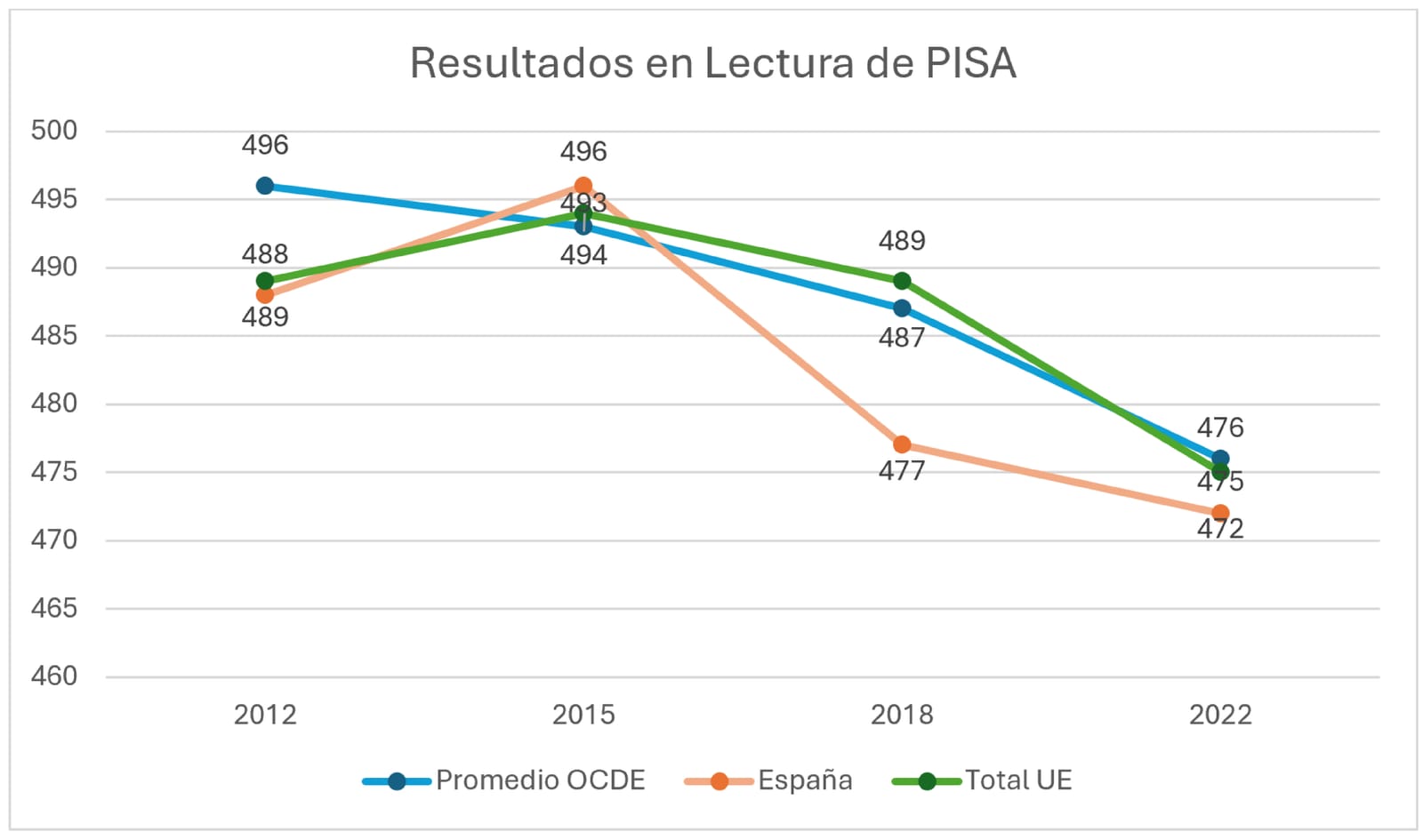 Note. Figure 1 presents the changes in estimated average reading performance between 2012 and 2022 in Spain, the OECD countries, and the EU. Several countries have experienced significant declines, including Spain with a decrease of 14 points (INEE, 2023).
The invisible cost: mental health and attention
The use of social media also affects the psychological well-being of young people. The figures are alarming: 66.4% procrastinate, 37.5% report stress, 27.9% anxiety, 55.1% isolation, 26.9% loss of the sense of time, 60.8% insomnia, 44.9% difficulty concentrating, 28.9% low self-esteem, and 23.6% poor academic performance, among other consequences (Robledo et al., 2025). From a neurological standpoint, the constant consumption of short, engaging, and instantly accessible digital content (such as videos, memes, notifications, and messages) activates the brain’s reward circuits, particularly those linked to dopamine, the neurotransmitter associated with pleasure and motivation. The result is a tendency to postpone important tasks in exchange for immediate gratification (Robledo et al., 2025). The more accustomed a student becomes to this kind of fast, constant stimulation, the more tolerance their nervous system develops: the same dose of use stops generating the same emotional satisfaction as before. This creates a vicious cycle, in which more and more connected time is needed to feel the same initial level of gratification. The outcome is a spiral of dependency that not only compromises emotional well-being but also erodes the ability to concentrate, plan, carry out tasks, and sustain the discipline that studying requires (Robledo et al., 2025).
Why reading comprehension fails
Almeida (2022) identifies several factors that explain low levels of reading comprehension:
- A lack of reading or an insufficient amount of it
- Difficulties in decoding: that is, in transforming written signs into their corresponding phonemes, blending sounds, and recognizing words
- Confusion about what the task requires
- Poor vocabulary
- Limited prior knowledge
- Memory problems
- Lack of familiarity with comprehension strategies
- Little control over one’s own reading process
- Low self-esteem
- Lack of interest or motivation
- Excessive use of technology: mainly harming self-esteem and concentration.
Some keys to reversing the trend
According to Robledo et al. (2025), preventing this scenario requires adopting certain measures:
- Cultivate close bonds with important people, dedicating quality time to them
- Promote screen-free activities
- Set clear schedules and daily usage limits
- Work on emotional education and digital health
- Build a life project: having a purpose reduces excessive social media use. It’s worth clarifying that I did not address here the impact of artificial intelligence on procrastination and literacy skills, because the article would have grown much longer than planned. Even so, it is clear that using technology mindfully and with limits is essential for fostering healthy learning and developmental growth in children. After more than a decade listening to kids who can’t manage to understand what they read, I don’t believe the solution lies in blaming technology or idealizing how things were studied before. It lies in being present: staying involved, setting limits with judgment, and not outsourcing to a screen what an adult still needs to teach. That is where, as teachers and as families, we have more to do than we usually think.
References
- Almeida, S. M. (2022). Algunas causas del bajo nivel de la comprensión lectora en la educación actual. Revista científica de la facultad de filosofía, 14(1).
- Borbor Tomalá, C. A. (2024). Impacto del uso de las redes sociales en la comprensión lectora. UPSE.
- UNESCO. (2026). Día Internacional de la Alfabetización. https://www.unesco.org/es/days/literacy
- PISA. (2022). Programa para la Evaluación Internacional de los Estudiantes. Informe español. Librería.educacion.gob.es. https://www.libreria.educacion.gob.es/libro/pisa-2022-programa-para-la-evaluacion-internacional-de-los-estudiantes-informe-espanol_183950/
- Instituto Nacional de Evaluación Educativa (INEE). (2023). PISA 2022. Programa para la Evaluación Internacional de los Estudiantes. Informe español. Ministerio de Educación, Formación Profesional y Deportes. https://www.libreria.educacion.gob.es/libro/pisa-2022-programa-para-la-evaluacion-internacional-de-los-estudiantes-informe-espanol_183950/
- Robledo, F. B., Aguirre, Á. D. J. F., Castillo, R. E. T., & Ramírez, J. A. G. (2025). Uso excesivo de las redes sociales y su impacto en la salud mental: estrategias para afrontar los efectos negativos en los estudiantes de la ENMS de León. JÓVENES EN LA CIENCIA, 37, 1-14.
- RTVE.es. (2023, December 5). Informe PISA 2022: España baja en matemáticas, lectura y ciencias. RTVE. https://www.rtve.es/noticias/20231205/informe-pisa-2022-espana-baja-matematicas-lectura-ciencias/2464630.shtml
- Ruiz, X. E. R. (2026). Patrones de consumo en redes sociales y su relación con las competencias de comprensión lectora. Educación, Arte, Comunicación: Revista Académica e Investigativa, 15(1), 68-85.